


This paper examines the conditions under which the negative terminal (0V) of an isolated power supply may be connected to protective earth (PE). It discusses implications for safety, EMC, and compliance to relevant standards. Design guidelines are provided to help ensure proper grounding without compromising isolation or regulatory requirements.
Introduction
Delta power supplies are designed to comply with either Class I or Class II. Both types of power supplies are capable of operating without connection to earth ground on the output. In fact, users are often discouraged from making such connections. However, certain applications may require a connection to PE for functional or safety reasons. This paper provides guidance on when and how such connections should be made.
There are many terms used in grounding, this paper will further refer to the minus output of power supply as “0V” and Earth connection as “PE”.
Factors to Consider
The first factor when connecting 0V to PE is whether the power supply is galvanically isolated. Most Delta power supplies are isolated, except for some high-power lighting drivers. Always check the manufacturer’s data sheet for isolation details.
Connecting the output to PE requires careful consideration, as improper grounding can introduce interference and ground loops. Because of this, Delta cannot guarantee the EMC performance of the power supply when 0V is tied to PE. It is the customer’s responsibility to verify the EMC compliance of the entire system.
Equipment Earthing
One of the main purposes of earthing is to provide a common reference point and to ensure that equipment is safe to touch by the operator. Some regulations, such as IEC 60204-1, require grounding for circuits with voltages exceeding 50 V DC and up to 300 V DC. This requirement generally does not apply to most Delta power supplies, as they output below 60 V and comply with Safety Extra Low Voltage (SELV) standards.
Functional Earthing
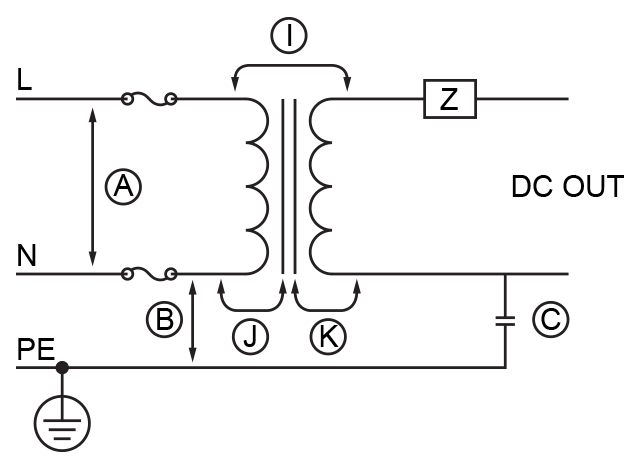
Another main reason to connect 0V to PE is to improve EMC performance. In most cases, there is no need to connect Vo− directly to PE, as a Y-class capacitor already couples the output to PE, as shown in Figure 1 labelled in (C). However, the user may connect the power supply output to PE when the application requires a common ground plane to reduce EMI.
Delta's Solution
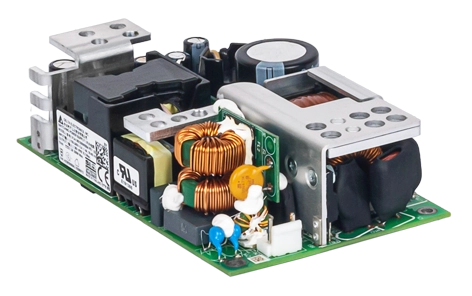
Delta’s open frame power supplies PJH Series is rated for both Class I and Class II applications and features a galvanic isolation of 4 kVac between input and output. This provides greater flexibility for the user, allowing connection or omission of PE, including the option to connect PE at the output.
For local purchase and service of industrial and medical power supplies, please contact our authorized distributors.