

SELV (known as Safety Extra Low Voltage in Appliance standards or Separated Extra Low Voltage in Installation standards) is defined within the basic standard IEC 61140:2016 “Protection against electric shock - Common aspects for installations and equipment” and described as “a secondary circuit which is so designed and protected that under normal and single fault conditions its voltages do not exceed a safe value”.
IEC/EN/UL product safety standards such as 60950-1 (withdrawn in December 2020), 60335-1 and 61558-1 are referenced to IEC 61140.
PELV (Protective Extra Low Voltage) is a system also defined in IEC 61140 which is not separated electrically from earth and other systems. But the voltage threshold limits of SELV also apply to PELV.
ES1 Note that the withdrawn IEC/EN/UL 60950-1 standards were replaced by IEC/EN/UL 62368-1 which are hazard-based standards focused on the identification of energy sources and prevention of potential harm including electrical shock and risk of combustion. Three electrical energy levels are defined as ES1, ES2 and ES3 for electrical hazards.
The terms SELV and PELV are not recognized in 62368-1 standards.
Although ES1 has a similar intent to SELV and PELV with respect to product safety, the terms are not considered as directly equivalent within their respective safety standards.
SELV System
SELV is electrically separated from earth (ground) and other nearby higher voltage systems, so that under normal and single fault conditions the voltage present at exposed conductive parts does not cause harm in the event of human contact. The absence of an earth connection means that any fault on the primary (mains) side (including earth faults with nearby systems) cannot cause a hazardous voltage on the secondary side. (See Figure 1.)
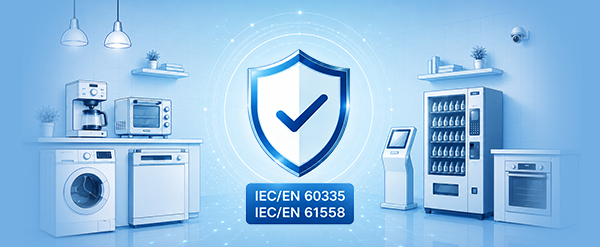
SELV systems are mandated in the relevant safety standards for applications and installations where operating electrical appliances could pose a serious safety hazard. Examples include household appliances, lighting control panels, factory or process automation, CCTV security systems and robotics.
Some product standards e.g., for medical devices/equipment and other specific equipment do not refer to SELV but have closely related requirements. (See below)
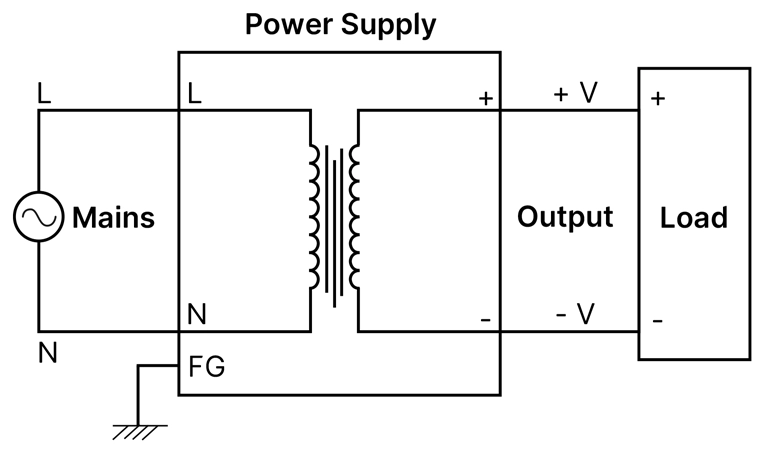
SELV Conditions
SELV systems are commonly specified with a maximum voltage of 50VAC or 120VDC, but Delta only uses the more stringent IEC/EN/UL interpretation of SELV for power supplies. According to which:
- In the case of normal conditions, the output voltage of a SELV power supply should not increase beyond a peak value of 42.4VAC (30VAC rms) or 60VDC. During normal operation these limits are restricted to a maximum of 200ms duration.
- In the case of a single fault condition, the output voltage of a SELV power supply should not increase beyond a peak value of 70VAC (50VAC rms) or 120Vdc. These limits are restricted to a maximum 20ms duration.
PELV System
As described above, PELV systems are similar to SELV but with the output grounded. So PELV systems must not exceed the maximum designated voltage levels under normal or single-fault conditions except for earth faults in other circuits. (See Figure 2.)
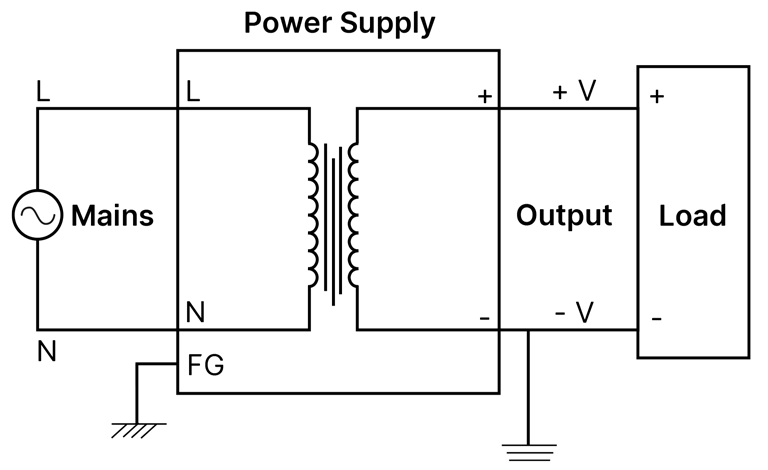
PELV Conditions
As for SELV the maximum voltage limits vary slightly according to the applicable standards chosen but for power supplies the corresponding SELV values are applied.
ES1 System
ES1 is part of a 3-class potential hazardous energy source defined with IEC/EN/UL 62368-1. Permissible voltage levels and fire risk are at the lowest level under normal, abnormal and single-fault conditions compared to the higher ES2 and ES3 levels. (See Figure 3.)
| AC up to 1kHz | DC | |||||
| RMS | PEAK | |||||
| V | I | V | I | V | I | |
| ES1 | 30V | 0.5mA | 42.4V | 0.707mA | 60V | 2mA |
| ES2 | 50V | 5mA | 70.7V | 7.07mA | 120V | 25mA |
| ES3 | >ES2 | |||||
| ES1 & ES2 must not exceed either the relevant voltage or current limit | ||||||
| ES3 exceeds both ES2 limits | ||||||
ES1 Conditions
ES1 (also known as a Class 1 electrical energy source) must not exceed the limits under the following scenarios:
- Normal operating conditions
- Abnormal operating conditions that do not result in single fault conditions
- Single fault conditions for parts not serving as a safeguard
For the above conditions, the voltage limits are 42.4VAC peak (30VAC rms) up to 1kHz and 60VDC. i.e., the same as SELV normal conditions.
When touched, ES1 levels are considered as “may be detectable but not painful and unlikely to cause injury”. In contrast ES2 levels are considered as “may be painful but unlikely to cause injury” and ES3 levels are considered as “capable of causing injury or death”. Mains voltage is ES3 level.
For single fault conditions of a basic safeguard the limits are class 2 (ES2) which are 70.7VAC peak (50V rms) and 120VDC.
SELV and PELV in AC/DC Power Supplies
Commonly available single-phase AC input power supplies (typically 120VAC or 230VAC nominal or “wide range”) are certified to the relevant IEC/EN/UL safety standards with suitable creepage and clearance spacings and reinforced/double insulation between the primary and secondary side of the transformer. This provides the necessary isolation required for SELV and PELV systems. The output wiring must have protective separation from cables/ systems with higher voltages eg. by using separate plastic conduits and also basic separation is required from other SELV and PELV circuits. Any plugs and sockets used in the system must not be interchangeable with higher voltage system connectors.
SELV compliant power supplies are designated as IEC Protection Class II products and marked accordingly. PELV compliant models are Class I products.
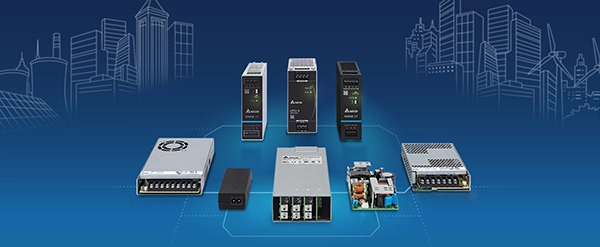
All Delta power supplies meeting the applicable safety standards and with output voltages < 60VDC maximum (i.e., if the maximum adjustment tolerance cannot exceed 60VDC) will meet the requirements for SELV and PELV systems.
Note that if two or more compliant power supplies are connected in series which results in the output voltage exceeding 60VDC then the system no longer meets SELV and PELV requirements. Suitable protective measures must then be taken to prevent accidental touching of any accessible part of the circuit.
Summary
Many AC/DC power supplies are designed for a range of applications and will have two or more product safety approvals that meet the specific requirements of each intended market. Dual 62368-1 and 60601-1 approvals are common for example, ensuring that both energy source and accessible voltage limits are met, thus simplifying integration into customer systems. However, each individual application will differ and must be carefully checked by the customer against the end system standards to ensure compliance – consulting with the power supply manufacturer if necessary.
For local purchase and service of Delta industrial and medical power supplies, please contact our authorized distributors.